What is the difference between solder adhesive (epoxy solder paste) and solder paste?
Epoxy solder paste (solder adhesive) and conventional solder paste differ significantly in composition, performance, and application scenarios. The following is a detailed comparative analysis:
1. Composition Differences: Formulation Logic Determines Functional Positioning
Solder Paste
Core components: Metal alloy powder (83%–90%) + flux (10%–17%).
Metal powder: Mainly lead-free alloys (e.g., SAC305, Sn99.3Cu0.7). Particle size is selected based on precision requirements (Type 3: 25–45 μm for mass production; Type 6: 5–15 μm for fine-pitch packaging).
Flux: Composed of rosin resin (provides tackiness), organic amine activators (remove oxides), and alcohol/ether solvents (adjust viscosity). Post-soldering residue must be controlled below 5%, and some no-clean types can directly meet RoHS requirements.
Functional positioning: Focused on “efficient formation of metallurgical joints.” The resin mainly provides temporary fixation during solder paste transfer, while the final joint performance is determined by the metal alloy.
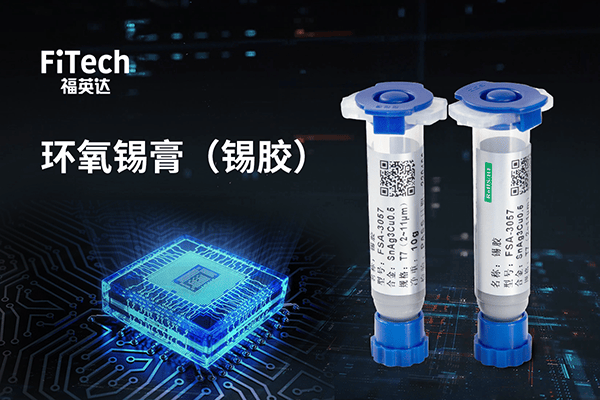
Epoxy Solder Paste (Solder Adhesive)
Core components: Solder powder (60%–85%) + thermosetting flux adhesive (15%–35%).
Solder powder: Various alloys can be used depending on temperature requirements (e.g., Sn42Bi57.6Ag0.4, melting point 138°C; Sn96.5Ag3Cu0.5, 219°C; Sn90Sb10, 245°C), with particle sizes ranging from T3 to T7.
Thermosetting flux adhesive: Typically based on bisphenol-A epoxy resin with anhydride curing agents, combined with weak organic acids (e.g., adipic acid) to avoid corrosion of the resin by highly active components. During soldering, it softens to assist component placement, and upon cooling, it cures into an insulating layer (2–10 μm thick), providing corrosion resistance and vibration resistance.
Functional positioning: Combines soldering with structural reinforcement. The synergy between resin and metal powder enables both electrical connection and mechanical support.
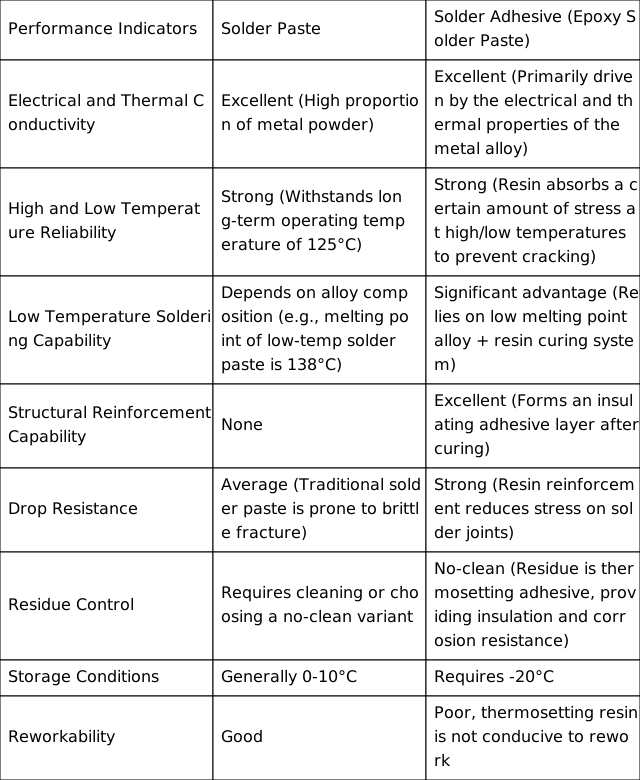
2. Performance Comparison: Key Metrics Define Application Boundaries
3. Application Scenarios: Matching Requirements Is Key to Selection
Typical Applications of Solder Paste
Mass production in consumer electronics: Smartphone motherboards (01005 passive component soldering), laptop GPUs (BGA-packaged chips), smart TV power boards. These require high printing precision (±5% thickness tolerance) and fast reflow compatibility.
Automotive electronics: PCB assemblies for vehicle control units (VCU) and dashboard driver boards. Sn99.3Cu0.7 solder paste is commonly used to withstand long-term operation at 125°C and pass AEC-Q100 thermal cycling tests.
Power device packaging: LED flip-chip bonding (ceramic substrate soldering) and industrial IGBT modules (high thermal conductivity requirements, typically using high-silver SAC405 solder paste).
Typical Applications of Epoxy Solder Paste (Solder Adhesive)
Flexible electronics: Foldable display UTG (ultra-thin glass) flexible substrate driver ICs, where soldering temperature must be ≤180°C to avoid substrate warpage. The ~170°C curing profile of epoxy solder paste is suitable, and the cured resin layer helps relieve bending stress.
Medical devices: Electrode soldering in glucose sensors (thermally sensitive biochips) and micro control units in pacemakers. Low residue and high insulation reduce short-circuit risks and meet medical certifications (e.g., ISO 10993).
Small-batch production / rework: Prototype PCBs in R&D (e.g., chip test boards with monthly volumes of 50–100 units, no stencil required—dispensing only) and localized rework in military products (irregular pads where stencil printing is not feasible).
4. Selection Guidelines: Precise Matching Based on Requirements
Production scale & precision
Choose solder paste for large-scale, high-precision (≤0.3 mm pitch), and high-power applications (e.g., automotive electronics, power devices).
Choose epoxy solder paste for small-scale, lower-precision, or heat-sensitive/flexible components (e.g., medical devices, foldable displays).
Cost & process compatibility
When monthly production exceeds 50,000 units, solder paste offers lower unit cost due to high printing efficiency.
When monthly production is below 10,000 units, epoxy solder paste is more cost-effective since it does not require stencils and supports flexible dispensing processes.
Reliability requirements
For applications requiring drop resistance, corrosion resistance, and high insulation (e.g., military or certain automotive uses), epoxy solder paste is often the only viable option.
For long-term high-temperature operation (e.g., automotive VCU), solder paste provides better reliability.


评论
发表评论